
Most leaders are one bad quarter away from finding out they’ve only ever been running on one engine.
A few years into any serious leadership role, you learn a strange truth: the people who look the most “successful” from the outside are often the ones closest to stalling out. The P&L is up and to the right. The title keeps getting bigger. And somewhere underneath all of it, the person is running on fumes — sleeping badly, snapping at their team, quietly wondering when the wheels come off.
I’ve lived enough of that story myself, and watched it play out in enough boardrooms, to stop treating it as a personal failing and start treating it as a design flaw. Not a flaw in the leaders. A flaw in how we define “performance” in the first place.
That question — what actually keeps a high performer flying, not just climbing? — is what led me to spend the last stretch of time building something I’m calling XGA.
This post is the first real look at it. I’m not going to hand you the whole blueprint — some of it is built for one-on-one conversations, not blog posts — but I want to take you deep enough into the thinking that you understand exactly why I built it the way I did, and why I think most performance advice you’ve been given is quietly incomplete.
The problem with single-engine performance
Picture a twin-engine aircraft. It can technically fly on one engine. Pilots train for exactly that scenario — it’s a survivable emergency, not a normal operating mode. But no airline schedules a flight assuming one engine stays off the whole way. Fly like that long enough, asymmetrically, under load, and eventually something gives: altitude, control, or both.
Now look at how most of us are taught to define a “high performer.” We’re taught to power one engine — usually the business one — as hard as it will go. Revenue. Market share. Promotions. Titles. And we’re taught, implicitly, that everything else — how you lead people, how you make decisions under pressure, how your body and mind hold up over a 30-year career instead of a 3-year sprint — is a personal matter. Something to sort out on your own time, if you have any left.
I don’t think that split survives contact with reality. I’ve sat across the table from brilliant operators who could read a balance sheet in their sleep and still couldn’t run a hard conversation with a direct report without it turning into a standoff. I’ve watched founders build genuinely excellent companies while quietly wrecking their health, their marriages, or their ability to sit still and think clearly for ten minutes. The business numbers looked fine — right up until the person behind them didn’t.
Business performance, human performance, and longevity aren’t three separate tracks you choose between. They’re three engines on the same aircraft. Underpower any one of them for long enough, and eventually the other two can’t compensate.
That’s the whole premise of XGA — the XCEED GROWTH ACCELERATOR program. Not a course. Not a framework you skim once and forget. A system built around three engines that have to be understood, diagnosed, and developed together, because in the real world, that’s how they actually operate.
Why “three engines,” not one big framework
I could have built XGA as one sprawling model with twenty boxes and arrows. I didn’t, on purpose.
The reason is that people rarely walk in the door needing all twenty boxes at once. A CEO staring down a stalled growth curve doesn’t want a longevity audit in the first conversation — they want to know why their market expansion plan isn’t working. A senior leader who’s technically excellent but keeps losing the room in high-stakes moments doesn’t need another sales framework — they need to understand their own decision-making under pressure. And a 45-year-old executive who’s finally admitting the 80-hour weeks aren’t sustainable doesn’t need a leadership model — they need a real, unglamorous plan for their body and mind over the next twenty years.
So XGA is built as three distinct engines, each one a complete system in its own right, each one able to stand alone as an entry point — and each one designed to eventually connect to the other two, because that’s where the real transformation happens.
Let’s go engine by engine.
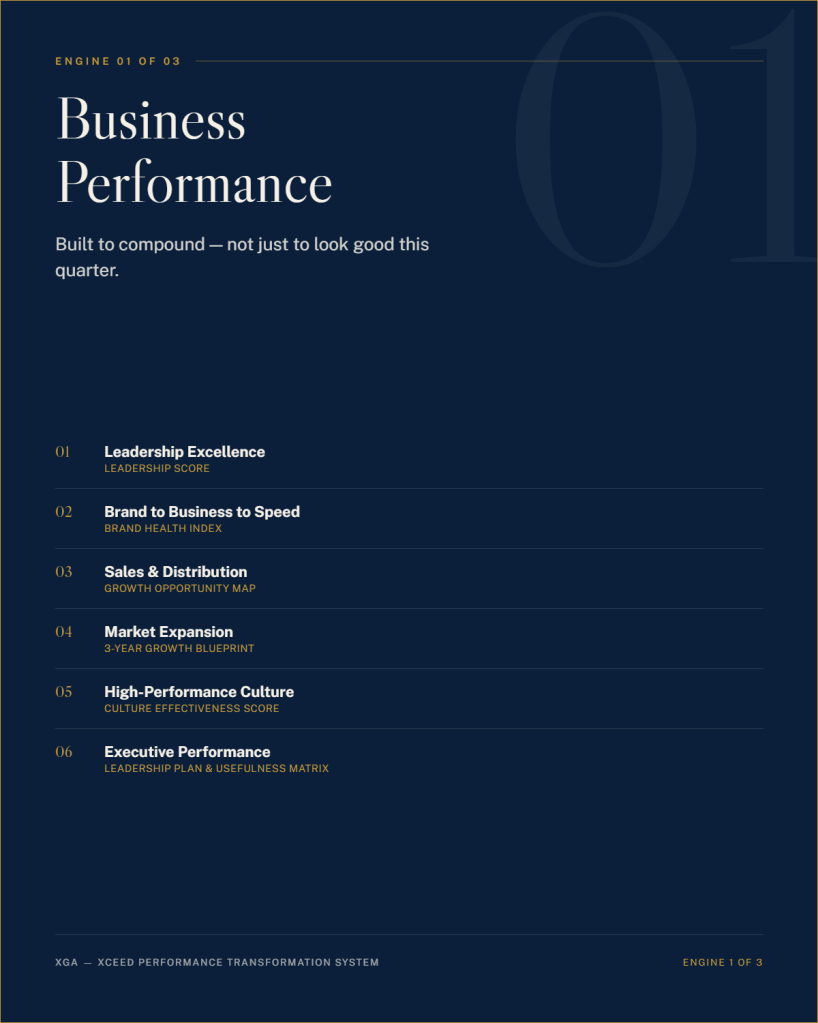
Engine 1: Business Performance
This is the engine most people expect, and the one I’d guess most readers came here half-expecting the whole post to be about. It’s the outward-facing machinery of a business — but examined at a level most performance conversations never reach.
Leadership Excellence sits at the top of this engine, and it’s deliberately not another generic “leadership styles” exercise. It’s about what leadership actually converts into — measured through what I call a Leadership Score, a way of making an otherwise fuzzy, subjective quality concrete enough to track and improve.
From there, the engine moves into Brand to Business to Speed — a pillar built around the idea that a brand isn’t a logo and a tagline, it’s the compounding asset that determines how fast a business can move. This is where consumer journey mapping lives, and where I track something I call the Brand Health Index: a way of seeing, numerically, whether your brand is actually pulling its weight or just sitting there looking presentable.
Then comes Sales and Distribution, mapped through a Growth Opportunity Map — because most businesses aren’t short on effort, they’re short on visibility into where the real, underexploited growth is actually sitting. And Market Expansion, which leans on a 3-Year Growth Blueprint and borrows deliberately from Blue Ocean Strategy thinking: the idea that the most durable growth often comes from competing where no one else has bothered to look, rather than fighting harder in an already-bloodied market.
The engine also refuses to let “culture” stay a soft, unmeasured word. High-Performance Culture is tracked through a Culture Effectiveness Score, treating culture as an operating variable, not a poster on the wall. And it closes on something deeply personal: Executive Performance, built around a Personal Leadership Plan and what I call a Usefulness Matrix — a tool for figuring out, with real honesty, where a leader’s time is actually creating value versus where it’s just… busy.
Six pillars. One engine. All of it built to answer a single question: is this business — and the leadership running it — actually built to compound, or just built to look good this quarter?
Engine 2: Human Performance
This is the engine most business frameworks skip entirely, and it’s the one I think matters most at the senior levels — because the higher you climb, the less your technical skill is the bottleneck, and the more you, as a human being under pressure, become the bottleneck.
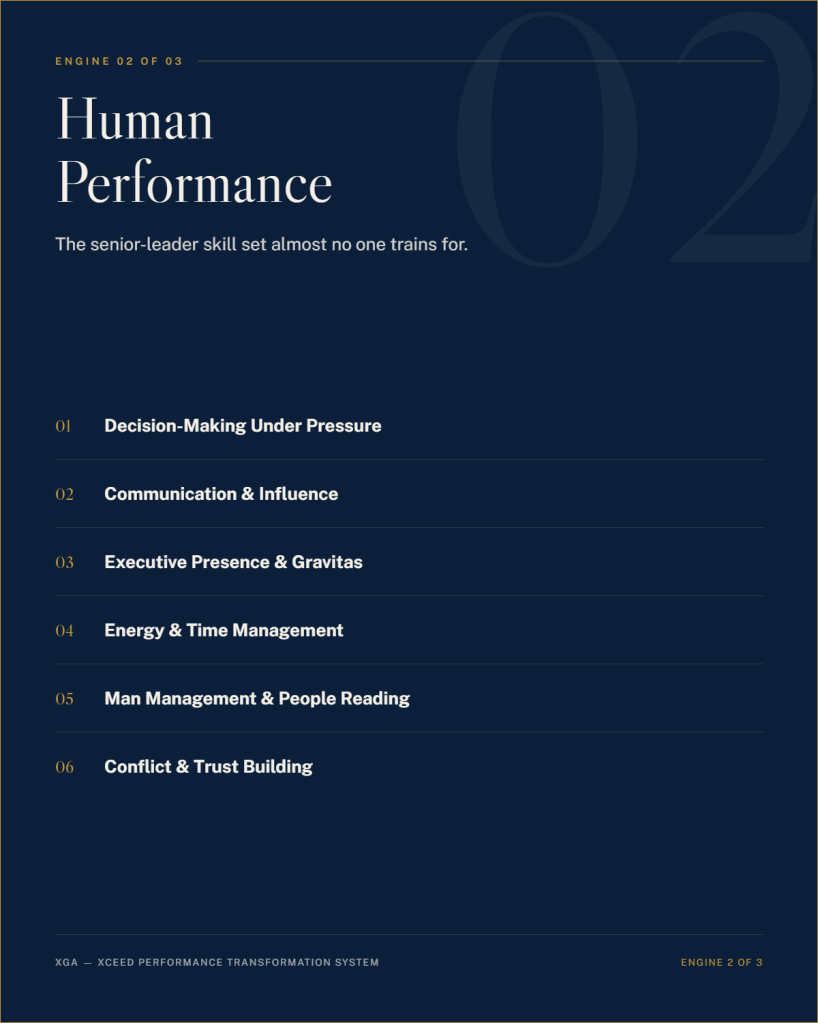
I deliberately built this engine for CEO-and-senior-leader reality, not entry-level soft-skills training. It’s not about learning to “communicate better” in the abstract. It’s about Decision-Making Under Pressure — how you actually think when the stakes are real and the clock is running, not how you’d like to believe you think in a calm debrief afterward. This is about CURE to VUCA that I also talk about. Next is about Communication and Influence at the level where a single sentence in a boardroom can move a decision worth millions. It’s about Executive Presence and Gravitas — the often-uncomfortable truth that being right isn’t the same as being heard, and being heard isn’t the same as being trusted.
It goes further into Energy, Time Management and Discipline, treated not as productivity-hack territory but as a genuine performance constraint — because a leader running on empty makes worse decisions than a mediocre leader running on full. Man Management and People Reading — the skill of actually seeing the people around you clearly, not just managing their outputs. And Conflict and Trust Building, because how a leader handles friction, disagreement, and repair after conflict tends to predict more about their long-term trajectory than almost anything else on their résumé.
None of this is soft in the dismissive sense of the word. It’s some of the hardest, least trained territory in a senior leader’s entire skill set — which is exactly why it gets its own engine instead of a single afternoon workshop.
Engine 3: Longevity
Here’s the engine most performance systems don’t even acknowledge exists — and it’s the one that eventually determines whether the other two even matter.
You can win at business performance and human performance for a five-year stretch and still lose the whole game if the body and mind carrying you through it give out at year six. Longevity, in the way I’ve built it into XGA, isn’t a wellness add-on. It’s a performance engine, evaluated with the same seriousness as the other two — and it comes with an explicit line I insist on: this is performance and lifestyle coaching, not medical diagnosis or treatment. It’s built to work alongside your doctor, never instead of one.
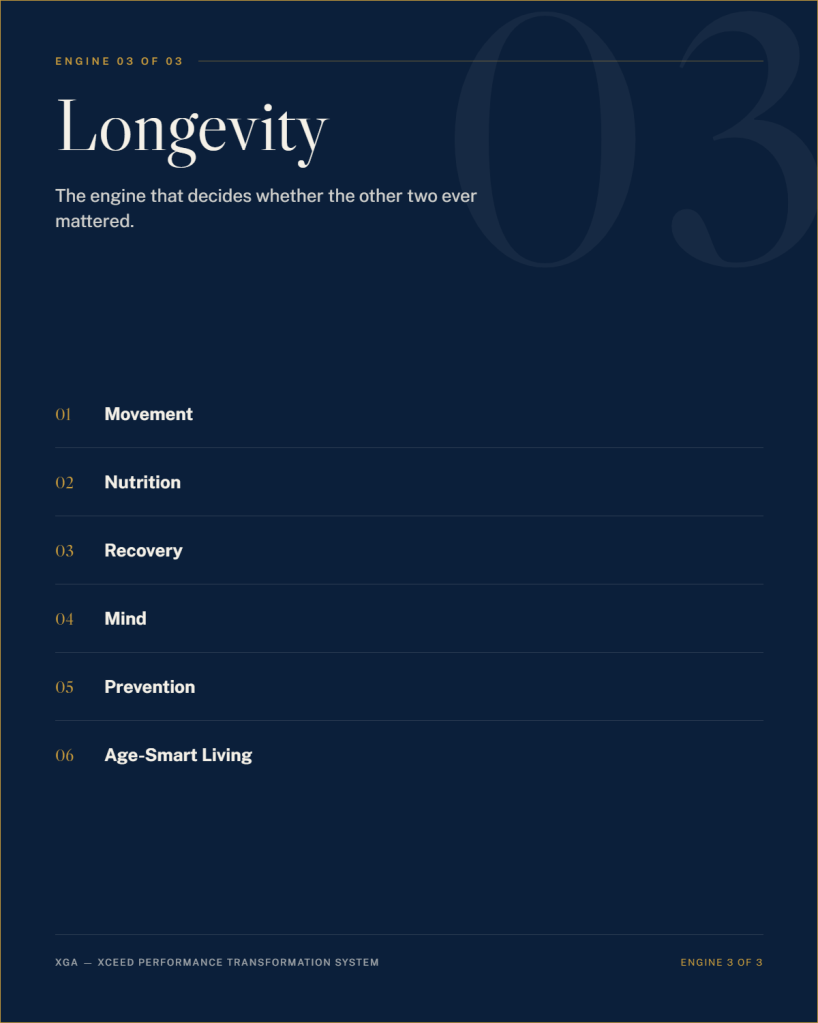
The pillars here are Movement, Nutrition, Recovery, Mind, Prevention, and what I call Age-Smart Living — the practice of making decisions today that your fifty-, sixty-, and seventy-year-old self will actually thank you for, instead of quietly resent.
This engine exists because I think the entire “grind now, recover later” model of high performance is a lie we tell ourselves when we’re young enough to get away with it. It works, right up until it doesn’t — and by the time it doesn’t, the cost of catching up is far higher than the cost of never falling behind in the first place.
What happens when the three engines run together
Individually, each engine is already a complete diagnostic and development system. But the actual unlock — the reason I built XGA as three engines instead of three separate products — is what happens when they’re read together.
A leader with a brilliant Growth Opportunity Map but a collapsing Culture Effectiveness Score is building growth on sand. A leader with flawless Executive Presence but no Recovery discipline is a leadership crisis waiting for a bad month. A leader who’s finally fixed their Energy and Time Management but still can’t read a Growth Opportunity Map is disciplined without direction. The engines cross-reference each other. That’s the point.
Every engagement I run moves through the same four phases, regardless of which engine — or combination of engines — someone walks in needing: Discover, where we get an honest, scored read on where things actually stand, not where the org chart says they should be; Design, where that diagnosis becomes a specific, prioritized plan instead of a generic list of good intentions; Deploy, where the plan actually gets lived, tested, and adjusted in real conditions, not in a workshop room; and Sustain, which is the phase almost every other performance program quietly skips — because a transformation that doesn’t survive six months without you in the room was never really a transformation, just a temporary performance.
Why I’m telling you this now
I didn’t build XGA as a side project or a slide deck to gather dust. I built it because I kept running into the same conversation, over and over, with sharp, accomplished people who were quietly stuck — succeeding on one engine while the other two idled or stalled, and no framework in front of them ever asked the right question about why.
If any part of this — the Leadership Score, the idea of a Usefulness Matrix, the honest reckoning of Executive Presence, the Age-Smart Living pillar — made you pause and think about your own three engines, that’s not an accident. That’s the whole point of writing this.
I’m not going to lay out the scorecards, the exact discovery process, or the full pillar-by-pillar mechanics here — some of this is built for a real conversation, not a blog post. But if you’ve read this far and you’re wondering which of your own three engines is quietly underpowered, that’s exactly the conversation I’d want to have with you.
Reach out. This is usually where the most interesting conversations can start.
— Laveen

